Choosing between a ball bearing and a roller bearing starts with understanding what your machine needs to handle. Ball bearings generally suit high-speed applications where low friction matters, while roller bearings typically support heavier loads. However, load direction, alignment and operating conditions also influence the choice.
This guide compares their load capacity, speed, friction and service life, using manufacturer data and practical selection advice to help you choose the right bearing for your application.
Key takeaway:
Ball bearings generally suit high-speed applications where low friction and smooth rotation matter.
Roller bearings generally support heavier loads than similarly sized ball bearings, particularly radial loads.
Misalignment tolerance depends on the bearing design. Both families include self-aligning options.
Matching dimensions alone is not enough for replacement. Confirm the full bearing reference, load requirements and operating speed.
Always check the manufacturer’s specifications for the selected bearing.
A bearing that fits the shaft can still be wrong for the job. It may support the required radial load but lack axial support, or its speed rating may apply to a different lubrication arrangement.
For maintenance teams and buyers, the useful comparison is therefore more specific than “balls for speed, rollers for strength.” The following guide explains what each family offers, where the general rules have exceptions, and which details to confirm before ordering.

Ball Bearing vs Roller Bearing: Key Differences
SELECTION FACTOR | BALL BEARINGS | ROLLER BEARINGS |
Rolling elements | Spherical balls | Rollers of different profiles |
Nominal raceway contact | Point contact | Line contact |
Load capacity at comparable dimensions | Often lower than a comparable roller design | Often higher than a comparable ball design |
Speed capability | Many designs suit high-speed operation | Certain designs also support high speeds |
Axial load support | Depends on contact geometry and arrangement | Depends on roller design, ribs and arrangement |
Misalignment | Self-aligning designs are available | Self-aligning designs are available |
Rigidity | Depends on design, load and preload | Often favoured where high rigidity and load capacity are required |
Maintenance | Depends on sealing, lubrication and operating conditions | Depends on sealing, lubrication and operating conditions |
Load Capacity and Speed:
A ball bearing uses balls between its raceways; a roller bearing uses rollers. Both belong to the rolling-element bearing family, and typical designs include bearing rings, rolling elements and a cage. For a fuller explanation of components, see our ball bearing article
The difference in contact geometry helps explain their load behaviour. Roller contact generally spreads load over a larger region, allowing many roller designs to achieve higher load ratings than similarly sized ball bearings.
“Point contact” and “line contact” describe idealized geometry. Under load, the surfaces deform elastically and develop a finite contact area. A loaded ball bearing, for example, has an elliptical contact patch rather than a mathematical point.
For buying or replacement decisions, use the catalogue load rating for the exact product. Two bearings with the same bore diameter can differ in outside diameter, width and internal construction. A useful comparison starts with equivalent dimensional constraints and the same intended duty.
Radial and axial loads:
A radial load acts perpendicular to the shaft. An axial load, also called thrust, acts along it. Many machines apply both at the same time.
Both bearing families contain designs intended for different loading directions. It is therefore inaccurate to say that all ball bearings carry axial loads or that all roller bearings carry only radial loads.
For example, a deep groove ball bearing can support axial loads in both directions within its limits. By contrast, an NU cylindrical roller bearing supports radial loading while permitting relative axial movement between its rings. These differences matter when one bearing must locate the shaft and another must allow thermal expansion.
When reviewing a proposed replacement, identify the force directions and the function of each bearing position. A larger radial load rating cannot compensate for missing axial locating capability.
Speed, friction and heat:
Ball bearings are often suitable for high speeds, but the actual speed limit depends on the complete bearing and its operating conditions. Certain cylindrical roller bearings also support high-speed rotation.
Friction is more complex than contact area alone. Rolling contact, sliding between components, seals, lubricant and preload can all influence resistance to rotation and heat generation. Heat dissipation also affects the bearing's operating temperature.
For a meaningful speed comparison, check:
The complete bearing reference and variant.
Whether the catalogue figure applies to grease or oil lubrication.
The manufacturer's load and operating-condition requirements.
The assembly's sealing, clearance or preload and thermal conditions.
A catalogue limiting speed is not an instruction to operate every installation at that speed. Compare like-for-like ratings, and assess the complete machine arrangement.
Misalignment, shock loads and bearing life:
Both families include self-aligning options. Self-aligning ball bearings and spherical roller bearings can accommodate specified angular misalignment; that capability does not extend to every ball or roller bearing.
If shaft deflection or housing alignment is a concern, compare the permitted misalignment for the exact product under its operating conditions. Do not apply a single allowable angle to the entire family.
Shock loads require a separate check of load peaks and static capacity. Severe loading can permanently deform raceways or rolling elements. A bearing selected only from a normal running-load estimate may not address those events.
Calculated fatigue life depends on load rating and equivalent dynamic load. Basic rating life, L10, describes rolling fatigue at 90% reliability for a population of identical bearings under specified conditions. It is not a guaranteed service interval.
Actual operating life can also be shortened by contamination, inadequate lubrication or incorrect mounting. Maintenance decisions therefore need more information than whether the bearing contains balls or rollers.
Common applications:
Application or requirement | Relevant starting point | What needs confirmation |
Electric motor with moderate loads and high-speed requirements | A suitable ball bearing design may be appropriate | Speed, actual loads, sealing and specified clearance |
Shaft carrying substantial radial load | A suitable roller design may provide the required capacity | Axial location, load rating and lubrication |
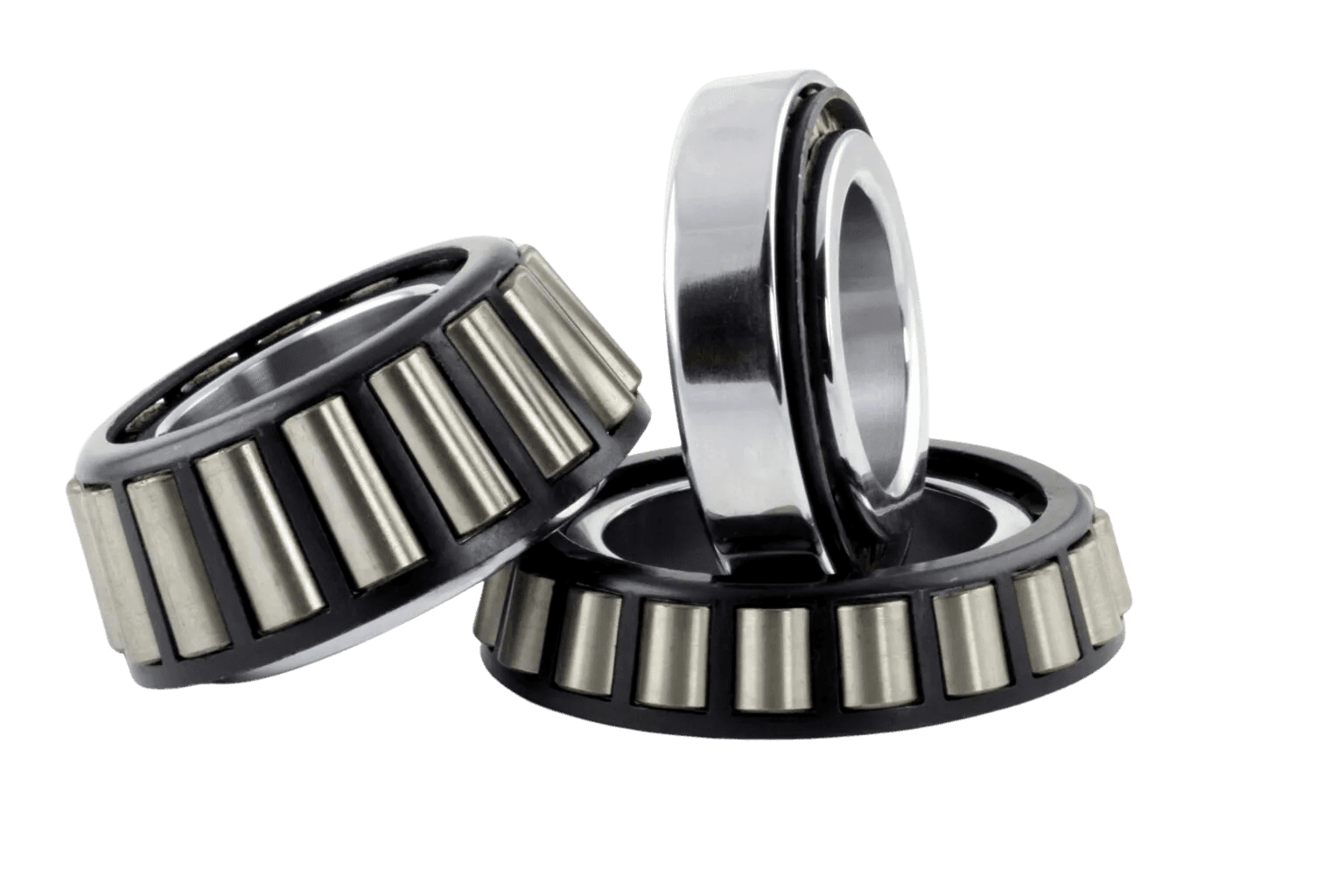
Truck or trailer wheel end | Follow the specified tapered bearing arrangement or hub unit | Vehicle, axle and complete bearing or hub reference |
Heavily loaded shaft with expected deflection | A self-aligning roller design may be relevant | Permitted misalignment, load direction and mounting |
How to choose and order the right bearing ?
For an existing machine, begin with the OEM specification and the full bearing reference, including suffixes. For a new selection or substitution, prepare the following information:
Dimensions: Bore, outside diameter, width and mounting geometry.
Loads: Radial and axial forces, their directions and any shock or variation.
Speed and duty: Normal speed, maximum speed and operating pattern.
Bearing arrangement: Which position locates the shaft and which permits axial movement.
Alignment and environment: Shaft deflection, temperature, dust, moisture and other contamination.
Lubrication and sealing: Lubricant, supply method and maintenance requirements.
Installation: Required shaft and housing fits, internal clearance or preload.
Fit and internal clearance affect performance. Incorrect choices can cause ring movement, excessive heat or other damage, even when the bearing family and dimensions appear suitable.
Both ball and roller bearings need appropriate lubrication. Sealed, pre-lubricated products and bearings operating with a separate lubrication system have different maintenance requirements. Follow the bearing and equipment instructions rather than assigning a maintenance interval by family.
Mineral Circles Bearings supplies automotive bearings as well as Industrial bearings from major brands, including NTN, SNR, SKF and NSK, to customers in Dubai, across the UAE, and throughout the Middle East and Africa.
For a quotation, send the full bearing reference, required quantity and delivery destination. If you are considering an alternative, include the equipment model and operating details so the application requirements can be discussed alongside availability and lead time.
Request a bearing quote from Mineral Circles Bearings.